U.S. scholarships for African students
The United States hosts more international students than any other country — 1.13 million in 2023/24, according to IIE Open Doors. Find fully funded scholarships, Fulbright awards, need-based Ivy-League aid and graduate assistantships open to African students, plus the F-1 visa and post-study work guidance families actually need.
The funding reality. Full-ride awards exist but are competitive. The most reliable routes for Africans are the Fulbright Foreign Student Program (Masters and PhD, applied for in your home country), the Mastercard Foundation Scholars Program (Arizona State, UC Berkeley, Michigan State, Duke, Carnegie Mellon and others), graduate teaching or research assistantships (most common in STEM PhDs), and need-based undergraduate aid at the small group of U.S. universities that meet 100% of demonstrated financial need for international students — Harvard, Yale, Princeton, MIT, Amherst, Dartmouth and Bowdoin are need-blind for internationals; Brown, Penn, Duke, Columbia, Georgetown, Notre Dame, Williams and Stanford are need-aware but still meet full need once admitted.
The application stack. Undergraduates apply through the Common Application, Coalition for College or direct portals, typically with SAT or ACT (now required again at MIT, Harvard, Yale, Brown, Dartmouth, Stanford, Caltech, Cornell and Georgetown — see our test-optional list), TOEFL/IELTS/Duolingo, two recommendations and a personal essay. WAEC, KCSE, NSC and A-Level results are well understood by U.S. admissions offices. Graduate applicants need transcripts, a statement of purpose, three references, and — for most STEM PhDs — the GRE.
Visa and post-study. Admission triggers an I-20 from the university, then the $350 SEVIS I-901 fee, a DS-160 and the F-1 visa interview at a U.S. Embassy or Consulate. After graduation, every F-1 student qualifies for 12 months of Optional Practical Training (OPT); STEM majors get a 24-month STEM-OPT extension on top of that. Longer-term, employer sponsorship via the H-1B lottery, O-1 extraordinary ability, or PhD-to-green-card routes (EB-1B, EB-2 NIW) are the standard pathways.




Loading…
Related pages
Read next
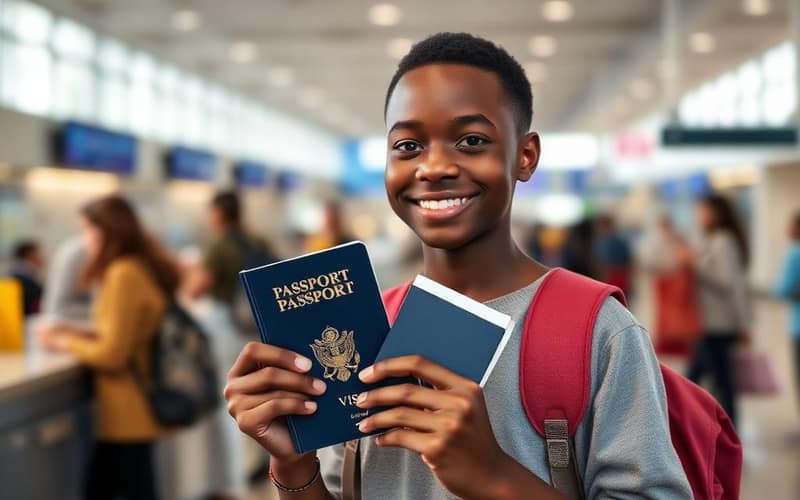
The Complete F-1 US Student Visa Guide for African Applicants
From DS-160 to your interview at the embassy — everything you need to walk in confident and walk out approved.
Read article
Fully Funded vs Partial Scholarships: What African Students Should Know
Understanding the real cost of 'partial' funding and how to combine awards into a fully funded package.
Read article
How to Write a Winning Scholarship Essay (with Examples)
A step-by-step framework used by Chevening, Mastercard and Fulbright winners — including the exact opening lines that work.
Read articleGuides for this destination
Long-form pathways into the strongest awards in this country.
U.S. F-1 student visa — full guide
Interview prep, financial documents and common rejection reasons.
How to write a winning scholarship essay
Structure, story arc and the rewrites that move the needle.
Statement of Purpose template (African students)
A field-proven SoP outline tailored to African applicants.
Frequently asked questions
Can African students get fully funded scholarships in the USA?
Yes, but they are competitive. The most established fully funded routes are the Fulbright Foreign Student Program (Masters and PhD, administered through your home-country U.S. Embassy or binational Fulbright Commission), the Mastercard Foundation Scholars Program at U.S. partner universities (currently Arizona State, UC Berkeley, Michigan State, Duke and Carnegie Mellon), and need-based undergraduate aid at the small group of U.S. universities that meet 100% of demonstrated need for international students.
What is the Fulbright Foreign Student Program?
Fulbright is the flagship U.S. Department of State scholarship for Masters and PhD study. It covers tuition, a monthly stipend, accident and sickness benefits, and round-trip airfare. African applicants apply in their home country through the U.S. Embassy's Public Affairs Section or the binational Fulbright Commission (Kenya, Egypt, Morocco, South Africa, etc.) — never directly to IIE in New York. In-country deadlines typically fall between February and May, more than a year before the intended start date.
Do I need SAT, ACT or GRE to apply?
Testing policy changed sharply in 2024. MIT, Harvard, Yale, Brown, Dartmouth, Stanford, Caltech, Cornell and Georgetown have reinstated the SAT or ACT for undergraduate admission. Many other U.S. universities remain test-optional and the entire University of California system is test-blind. For graduate study, the GRE is now waived at most Masters programmes but is still expected by most PhD programmes in STEM. See our full test-optional & test-blind list at /admissions/test-optional.
Which U.S. universities are most generous to African students?
Need-blind for international applicants (admit without considering ability to pay and then meet 100% of demonstrated need): Harvard, Yale, Princeton, MIT, Amherst, Dartmouth and Bowdoin. Need-aware but still meet 100% of demonstrated need once admitted: Brown, Penn, Duke, Columbia, Georgetown, Notre Dame, Wesleyan, Williams and Stanford. For African families with limited savings, these institutions are often more affordable than a public flagship that gives only partial merit aid.
Can I work in the U.S. on a student visa?
F-1 visa holders can work up to 20 hours per week on campus during the academic term and full-time during official school breaks. After completing one full academic year of enrolment, students become eligible for Curricular Practical Training (CPT) for course-related internships. After graduation, all F-1 students qualify for 12 months of Optional Practical Training (OPT). Students in a DHS-designated STEM major can apply for a 24-month STEM-OPT extension, for a total of 36 months of post-graduation work authorisation.
When should we start the U.S. application?
Begin 12–18 months before your intended start date. Undergraduate: the Common App opens 1 August; Early Decision and Early Action deadlines are 1–15 November; Regular Decision deadlines are 1–15 January. Graduate: most deadlines fall between 1 December and 1 February for the following August intake. Fulbright in-country deadlines run February–May, more than a year ahead.
What is the SEVIS I-901 fee and how does the F-1 visa interview work?
Once a university issues your I-20, you pay the $350 SEVIS I-901 fee online, then complete the DS-160 visa application and book an F-1 interview at the U.S. Embassy or Consulate in your country. At the interview, a consular officer assesses whether you are a genuine student with strong ties to your home country (section 214(b) of the Immigration and Nationality Act). Bring your I-20, financial evidence covering at least one year of costs, academic transcripts and admission letter. F-1 holders can enter the U.S. up to 30 days before the I-20 programme start date.
How much should we budget if a scholarship doesn't cover everything?
For 2025–26, total all-in cost (tuition, fees, housing, food, health insurance, books, travel) is roughly USD 55,000–75,000 per year at a public flagship as an out-of-state international student, USD 80,000–95,000 at a private university, and USD 15,000–25,000 per year at a community college (a common transfer pathway into a four-year university for the final two years). Do not take on private debt to cover a partial scholarship — apply again the following cycle, target need-blind universities, or use the community-college transfer route.
What happens if my child's F-1 visa is denied or delayed?
The most common refusal is under section 214(b) — failure to demonstrate non-immigrant intent. You can re-apply with stronger evidence of ties to your home country and clearer funding. If the visa is simply delayed past orientation, contact the host university's Designated School Official (DSO) in the International Student Office immediately. They can issue a new I-20 with a deferred start date; most U.S. universities will defer admission and any scholarship by one semester or one full year. Travel ban or administrative-processing cases (221(g)) are handled the same way.
Don't miss the next deadlineGet U.S. scholarships for African students straight to your inbox.
Get weekly funded opportunities, deadlines and application tips — free.